
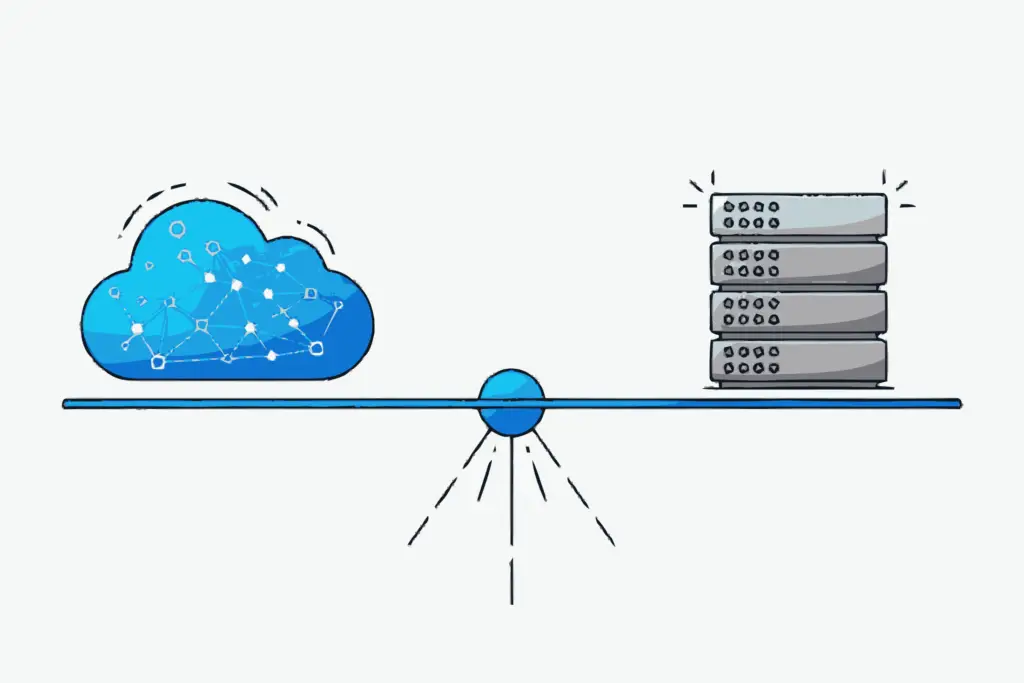
Somewhere in the life of nearly every growing business comes a technology decision that sounds far more intimidating than it needs to: should we run our systems in the cloud, or on our own hardware here in the office? The question gets wrapped in jargon and vendor sales pitches until it feels like something only an IT department could answer. At Ohana Digital, where technology consulting is part of what we do, we like to strip this decision back to plain language, because the underlying tradeoffs are genuinely understandable, and the right answer depends on your specific business rather than on whatever a salesperson is pushing.
This post explains what “cloud” and “on-premise” actually mean, the real advantages and drawbacks of each, and how to think about which fits your business. There is no universally correct answer, only the answer that is right for your situation, and understanding the tradeoffs is what lets you make that choice with confidence rather than confusion.
What the two options actually mean
Let us start with plain definitions, because the terms get thrown around loosely. On-premise means your business runs its systems, servers, software, and data storage on hardware that you own and keep physically at your location. You buy the equipment, you house it, and you are responsible for maintaining it. This was the default model for decades: a server room or closet, humming away in the office.
Cloud means your systems, software, and data run on infrastructure maintained by a provider and accessed over the internet, rather than on hardware you own and house. Instead of buying and maintaining your own servers, you essentially rent computing resources from a provider who handles the underlying infrastructure. When you use web-based software, store files in an online service, or run applications you access through a browser, you are using the cloud.
Most modern businesses actually end up somewhere on a spectrum between these, using cloud services for some things and keeping others in-house, an approach sometimes called hybrid. But understanding the two poles clearly is what lets you make sensible decisions about where any given system should live.
The case for the cloud
The cloud has become the default choice for a great many small businesses, and for good reasons worth understanding.
The biggest advantage is that someone else handles the infrastructure. With cloud services, the provider maintains the servers, applies updates, and manages the underlying technology, which removes an enormous burden from a small business that lacks a dedicated IT team. You are freed from buying, housing, and maintaining expensive hardware.
The cloud also shifts costs from large upfront purchases to predictable ongoing subscriptions, which can be far easier for a small business to manage than a big capital outlay for equipment that will eventually need replacing. You pay for what you use, and you avoid the cost and hassle of hardware that depreciates and ages.
Accessibility is another major benefit. Because cloud systems are accessed over the internet, your team can reach them from anywhere, which supports remote and flexible work in a way that on-premise systems struggle to match. For a business with people working from different places, or across different locations, this flexibility is genuinely valuable.
Scalability rounds out the case. Cloud resources can typically be scaled up or down easily as your needs change, so you are not stuck with too little capacity during a busy period or paying for too much during a slow one. This flexibility suits businesses whose needs fluctuate or grow.
On security, it is worth noting that reputable cloud providers invest heavily in protecting their infrastructure, often far more than a small business could on its own. The U.S. Small Business Administration’s guidance on strengthening your cybersecurity emphasizes protections like keeping systems updated, strong access controls, and backups, and established cloud services handle much of this heavy lifting as part of their offering, which can actually raise the security bar for a small business rather than lower it.
The case for on-premise
On-premise is not obsolete, and for certain businesses it remains the right choice. Understanding its advantages keeps the decision honest.
The primary appeal of on-premise is control. When your systems and data live on hardware you own and house, you have direct, complete control over them, which some businesses need or prefer, particularly those with specific requirements around exactly how and where their data is handled. For businesses in certain regulated industries, or with particular compliance obligations, this direct control can matter.
On-premise can also make sense when you have specialized needs that cloud services do not serve well, when you have already invested heavily in on-premise infrastructure, or when your circumstances, such as unreliable internet, make dependence on internet-accessed systems risky. If your operations cannot tolerate being cut off when the connection drops, systems that live entirely in the cloud introduce a real vulnerability.
The tradeoffs, though, are significant and worth stating plainly. On-premise means you bear the full responsibility, and cost, of buying, housing, maintaining, updating, and securing your own hardware, which requires either in-house expertise or a partner to manage. That is a meaningful ongoing burden, which is exactly why so many small businesses have gravitated toward the cloud.
How to choose
Since there is no universal answer, the right choice comes from weighing the tradeoffs against your specific situation. A few questions help clarify it.
How much technical capacity do you have? Businesses without dedicated IT resources often benefit from the cloud precisely because it offloads infrastructure management. How do you prefer to handle costs? If predictable subscriptions suit you better than large upfront purchases, that points toward the cloud; if you have already invested in infrastructure, that may favor on-premise. How important is remote access and flexibility? Teams that work from multiple places or locations are well served by the cloud’s accessibility. Do you have specific control, compliance, or specialized requirements? Those may point toward keeping certain systems on-premise. And how reliable is your internet? Heavy cloud dependence assumes a solid connection.
For most small businesses, the answers increasingly point toward the cloud, or a hybrid approach, because the cloud removes so much of the infrastructure burden that small businesses are least equipped to carry. But the point is not to follow a trend; it is to match the setup to your genuine needs. The best decisions here come from understanding your own situation clearly, which is exactly where thoughtful guidance helps, and it reflects the consulting mindset our team brings, which you can read more about on our who we are page.
Making the transition thoughtfully
For many businesses, the practical question is not simply “cloud or on-premise” in the abstract but “should we move something we currently run on-premise to the cloud, and how?” Transitions like this are common as businesses grow and as cloud services mature, but they deserve to be handled thoughtfully rather than rushed, because a poorly managed migration can create real disruption.
The first principle is to move deliberately, not all at once in a panic. Many businesses find that a gradual, considered transition, moving systems to the cloud as it makes sense rather than in a single sweeping change, is far less disruptive and lets them learn as they go. There is rarely a need to overhaul everything overnight, and a phased approach reduces risk while letting you confirm that each move actually delivers the benefits you expected.
The second principle is to protect your data throughout. Any transition involves moving or copying important data, and that is precisely the moment when data is most vulnerable to loss or error. Ensuring you have secure, tested backups before you begin, and confirming that everything transfers correctly and remains accessible, protects you against the mistakes that can turn a migration into a crisis. The security and continuity fundamentals do not pause during a transition; if anything, they matter most then.
The third principle is to plan for the practical realities. Consider how a change will affect your team’s daily work, what they will need to learn, and how you will maintain operations during the transition. Consider the ongoing implications too: how the new setup will be maintained, secured, and supported once the move is complete. A transition is not finished when the data lands somewhere new; it is finished when the new arrangement is running smoothly, securely, and sustainably.
Above all, let the decision and the transition be driven by your genuine needs rather than by pressure or trend. Moving to the cloud, staying on-premise, or adopting a hybrid mix are all legitimate choices, and the right path is the one that genuinely serves your business, implemented carefully enough that it improves your operations rather than disrupting them. This is exactly the kind of decision where unbiased, experienced guidance is worth far more than a vendor’s sales pitch, because the goal is your success, not a particular product.
Don’t forget the fundamentals, wherever your systems live
Whichever path you choose, certain fundamentals apply regardless. Your data needs to be backed up securely. Your systems need to be kept updated and protected. Access needs to be controlled so only the right people can reach sensitive systems. These security and continuity basics matter whether your systems live in the cloud or in a closet down the hall, and the Federal Trade Commission’s guidance on cybersecurity for small business applies across both models. The cloud-versus-on-premise decision changes who handles some of this and how, but it never eliminates the need to attend to it. This is part of the broader IT solutions thinking we bring to every business, because the right infrastructure choice is only valuable if it is also secure and reliable.
Common mistakes in the cloud-vs-on-premise decision
A few mistakes lead businesses astray. The first is choosing based on what a salesperson is pushing rather than on the business’s genuine needs. The second is assuming the cloud is automatically less secure, when reputable providers often invest far more in security than a small business could alone, or conversely assuming the cloud is automatically more secure and neglecting your own responsibilities. The third is ignoring internet reliability when leaning heavily on cloud systems, creating a single point of failure. The fourth is treating it as an all-or-nothing choice, when a hybrid approach often fits best. And the fifth is neglecting the fundamentals, backups, updates, access control, regardless of which model you choose. Avoiding these leads to a setup that genuinely serves your business.
The reassuring truth is that this decision, intimidating as it sounds, is genuinely knowable once the jargon is stripped away. It comes down to understanding a handful of tradeoffs and matching them honestly to your own situation. Businesses make this choice well every day, not by mastering technical minutiae, but by getting clear on their real needs and, where helpful, leaning on guidance they can trust. You do not need to become an infrastructure expert; you need a clear-eyed sense of what your business actually requires.
The Ohana Digital approach
Technology decisions like this one are exactly where a trusted partner earns their keep, cutting through jargon and vendor pressure to help you make the choice that is genuinely right for your business. That kind of honest, in-your-corner guidance is very much in the spirit of ohana, where you look out for one another’s real interests rather than pushing an agenda.
We help businesses across Greater Philadelphia and Honolulu make sound technology decisions, weighing cloud, on-premise, and hybrid approaches against their actual needs, budget, and circumstances, and then implementing whatever they choose securely and reliably. If you are wrestling with where your systems should live, or you simply want a straight, jargon-free conversation about your options, we would be glad to help. Reach out through our contact page, and let us help you build a technology foundation that fits your business rather than someone else’s sales pitch.